Seasonal Fashion Accessories: Strategic Sourcing, Market Insights, and Global B2B Opportunities
Seasonal fashion accessories are more than finishing touches. They are high‑margin products that drive innovation, encourage brand loyalty and fuel international trade. Think about your favorite scarf or pair of sunglasses. Each item represents a complex network of designers, artisans and exporters.
For small‑ and medium‑sized enterprises (SMEs), manufacturers, exporters, importers, wholesalers and sourcing professionals, accessories such as scarves, hats and sunglasses are lucrative opportunities because they are lightweight, easy to ship and updated frequently to meet changing trends. Global B2B platforms like fashion accessories wholesale connect companies in Dhaka, Detroit or Dubai with vetted suppliers worldwide.
This article helps trade professionals understand the economic landscape and sourcing strategies behind three major accessory categories-scarves, hats and sunglasses-and offers practical guidance for leveraging seasonal demand.
Drawing on recent market research, trade insights and best practices, it explains how to make informed sourcing decisions, optimize inventory, and build resilient supply chains. Whether you are a wholesaler seeking to diversify your product portfolio or a manufacturer looking to expand your export reach, the following sections provide a roadmap.
Market Landscape and Statistics
Before sourcing or exporting seasonal accessories, it helps to know how big the markets are and where they are headed. Recent reports show that fashion accessories are among the fastest‑growing segments in global apparel trade.
Demand is driven by impulse purchases on e‑commerce platforms, the athleisure trend, rising disposable incomes and a growing preference for sustainable materials. Once viewed as complements, accessories like scarves, hats and sunglasses have become high‑margin essentials for brands and retailers.
Table 1 – Market size and projected growth by category
| Accessory category | 2024 market value (US$ bn) | 2025 value (US$ bn) | Forecast value & year | Compound annual growth rate (CAGR) | Key growth drivers (selected) |
| Scarves & shawls | 24.72 | 26.22 | 45.88 (2032) | 8.32% | Rising disposable incomes, popularity of personalized products and support for traditional textiles |
| Hats & headwear | 10.51 | 11.04 | 16.61 (2032) | 6.01% | Fashion consciousness, athleisure trends, functional headgear demand and e‑commerce penetration |
| Sunglasses & eyewear | 18.11 | 18.93 | 23.71 (2029) | 4.5-5.8% | Outdoor recreation, UV‑protection awareness, social media influence and technology integration |
The data shows that scarves and shawls have the fastest growth rate. Hats and headwear are close behind, while sunglasses grow at a steady but slightly slower pace. Even though the CAGR for sunglasses is modest, this category still represents billions of dollars and offers niches from polarized sports eyewear to AI‑enabled smart glasses.
Regional trends matter too. Asia‑Pacific is the fastest‑growing region for apparel accessories because of cost‑effective production in China, India and Vietnam and rising middle‑class consumption. North America and Europe demand premium and sustainable accessories, while Middle Eastern buyers favor high‑quality scarves and embellished items.
Visualising the market growth
The bar chart below compares the 2024 market value of scarves & shawls, hats, and sunglasses with the forecast value. It highlights which categories are expected to expand most rapidly over the coming years.
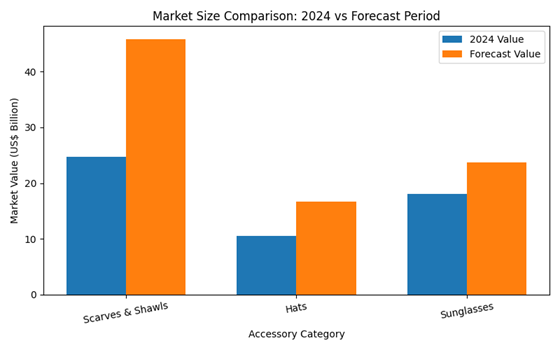
Market comparison chart showing 2024 vs forecast market values for scarves, hats and sunglasses
Figure 1 – Comparison of current and forecast market sizes for scarves & shawls, hats and sunglasses. The chart underscores the sharp increase projected for scarves & shawls and hats relative to sunglasses.
Scarves & Shawls: Elevating Style and Business
Scarves and shawls are versatile. They have cultural significance and provide numerous B2B opportunities, ranging from mass‑market polyester scarves to premium cashmere shawls and hand‑embroidered silk pieces. The global scarves & shawls market is poised to grow from US$ 26.22 billion in 2025 to US$ 45.88 billion by 2032, representing a CAGR of 8.32%. Asia‑Pacific dominates this segment, holding 37.86 percent of the market in 2024.
Materials and customization
Scarves come in many materials-silk, wool, cashmere, pashmina, cotton and synthetic fibers. Each material affects price, texture and seasonality:
- Silk and cashmere: These luxury fibers command high unit values. They appeal to premium consumers in Europe, the Middle East and Japan. For example, a classic red cashmere scarf from Nepal showcases pure Himalayan cashmere and a certificate of authenticity. Silk scarves, which could hold 32.91 percent of scarf revenue in 2025, require verifying ethical farming and dyeing practices to meet the expectations of eco‑conscious buyers.
- Wool and pashmina: Ideal for winter, these fibers are popular in pashmina shawls from India and Nepal. Government incentives preserve traditional hand‑loomed pashmina weaving. Woolen accessories can range from a handmade woolen muffler crafted in Bangladesh to an artisanal pashmina wrap from Nepal.
- Cotton and blends: Lightweight and breathable, cotton is great for summer. Cotton scarves are affordable, hypoallergenic and easily dyed. A colorful screen print cotton shawl from Bangladesh illustrates how block printing and hand stitching can add value without raising costs too much.
- Synthetic and performance fabrics: Microfiber and UV‑protection scarves are gaining popularity among outdoor enthusiasts. They offer moisture‑wicking and temperature regulation. Some SMEs source blends that include recycled polyester or milk cotton yarn for scarves and hats to combine softness with sustainability.
Personalization matters. Consumers appreciate scarves that reflect their identity. You can offer monogramming, unique color combinations or culturally specific patterns. The growing popularity of customized products boosts engagement and loyalt. For instance, you might incorporate a regional motif into a limited‑edition series or allow clients to choose their fabric mix.
Sourcing considerations for scarves
- Region selection: Countries such as India, Bangladesh, Vietnam and China are top sources for bulk scarf production. Italy and Turkey specialize in premium silk and wool blends. When you select suppliers, look beyond price. Consider their ability to scale, meet quality standards and deliver on time. Tools like B2BMAP let you browse supplier profiles; check out Aaquib Handloom’s Arafat scarf or Crecent Global Trading’s cotton shawls to compare offers.
- Sustainability: Buyers care about eco‑friendly materials and fair labor. Source from mills that use recycled polyester, organic cotton or natural dyes. Certifications such as OEKO‑TEX, GOTS and Fair Trade can add credibility.
- Seasonality: Stock lightweight cotton or linen scarves for spring and summer. Reserve wool and cashmere for fall and winter. Pay attention to local festivals; pashmina shawls often see spikes around Diwali and Eid. If you need yarn for custom orders, consider milk cotton yarn that comes in multiple plies and colors.
- Packaging and labelling: Protect delicate fibers with moisture‑resistant bags. Biodegradable or recycled packaging can appeal to eco‑conscious buyers.
Selling opportunities
- Wholesale and private label: Online retailers and boutique chains seek private‑label scarf lines. Offer design options, flexible minimum order quantities (MOQs) and quick turnaround times.
- Corporate gifting: Branded scarves make excellent corporate gifts. Companies are often willing to pay a premium for bespoke designs.
- Cultural collections: Collaborate with artisans to produce limited‑edition collections. Traditional motifs can attract niche markets and justify higher margins.
Have you ever thought about how many hands weave a single muffler? Knowing your supply chain allows you to tell authentic stories and justify your price.
Hats & Headwear: Blending Fashion, Function and Technology
Hats and headwear are experiencing a renaissance. Once considered utilitarian, hats now sit at the intersection of fashion and function. The global hats market reached US$ 10.51 billion in 2024 and is projected to grow to US$ 16.61 billion by 2032, with a 6.01% CAGR. This growth is propelled by rising fashion consciousness, the athleisure movement and demand for stylish yet functional headgear.
Market drivers and consumer trends
- Athleisure and sports: Athleisure has blurred the lines between sportswear and streetwear. Baseball caps, visors and performance beanies have become everyday staples. For cold weather or tactical use, balaclavas for men and women combine warmth with breathability. The sports segment is expected to grow quickly thanks to increased participation in outdoor activities and the integration of sports caps into casual outfits.
- Fashion innovation: Social media, celebrity endorsements and nostalgia for vintage styles such as bucket hats and fedoras drive demand. Even a playful cap with flip‑down lenses, like the hat brown sunglass, can inspire a viral trend.
- Smart technology: A handful of brands now offer hats with built‑in biometric sensors, temperature regulation or moisture‑wicking fabrics. Although these products target niche markets, they show how headwear is evolving.
- Sustainability: Consumers ask for eco‑friendly materials like recycled polyester and organic cotton. Some suppliers offer hemp or bamboo blends. Companies that champion sustainability differentiate themselves and appeal to climate‑conscious buyers.
Sourcing considerations for hats
- Material selection: Polyester dominates the market thanks to durability and moisture‑wicking properties. Cotton is prized for breathability, while wool remains essential for knit beanies and luxury felt hats. When evaluating suppliers, look for those who offer multiple materials and finishes. In cold climates, balaclavas or knitted beanies may outsell sun hats.
- Regional hubs: China, Vietnam and Bangladesh excel at affordable caps. Italy and Ecuador (for Panama hats) deliver premium craftsmanship. A knit cap manufacturer such as Nantong Yonghui Craft Clothing in Jiangsu, China produces woven, knitted and crochet hats at scale.
- Design customization: Buyers want unique details-embroidery, patches, digital prints or adjustable closures. Offering customization can differentiate your business.
- Compliance and safety: Industrial helmets and high‑visibility caps require compliance with safety standards. Even fashion hats may need flammability and chemical compliance checks in markets such as the U.S. and EU.
- Inventory management: Headwear is seasonal. Knit beanies sell in winter, while straw hats and visors sell in summer. Plan production cycles carefully to avoid overstocking.
Business opportunities
- Private label manufacturing: Many apparel brands outsource hat production. Offering small MOQs and design support can attract start‑ups and influencers launching limited collections.
- Event merchandising: Sports teams, music festivals and corporate events frequently order customized hats. Bulk orders with quick delivery can secure these clients.
- Sustainable collections: Develop lines using organic cotton, hemp or recycled plastics. Highlight sustainability credentials in your marketing.
Sunglasses & Eyewear: Protecting Eyes and Expanding Markets
Sunglasses blend style with eye protection. The global sunglasses market reached US$ 18.11 billion in 2024 and is projected to grow to US$ 23.71 billion by 2029. Although the growth rate is slightly lower than for scarves and hats, the market remains attractive because of its diversified sub‑segments (fashion, sport, prescription) and technological innovation.
Demand drivers and trends
- Outdoor recreation: More people are hiking, cycling and engaging in outdoor sports, so demand for UV‑protection sunglasses is rising.
- Health awareness: Consumers understand the importance of UV protection. Educating buyers about UVA/UVB filtering can differentiate your product.
- Social media and celebrity influence: Influencers and celebrities frequently launch collaborations with eyewear brands. Unique frame shapes-oversized cat‑eye or vintage aviators-become viral trends.
- Smart eyewear: Technology is creeping into eyewear. Smart glasses such as BG02 audio Bluetooth sunglasses, BG01 smart audio glasses and BG09 smart glasses combine audio playback with UV protection. High‑performance designs like anti impact sports sunglasses cater to athletes who need robust frames and polarized lenses.
Sourcing considerations for sunglasses
- Lens quality: Ensure lenses provide certified UV400 protection. Polarization reduces glare for drivers or boaters. For sports eyewear, polycarbonate lenses are ideal.
- Frame materials: Acetate is durable and eco‑friendly. Stainless steel is lightweight and hypoallergenic. TR‑90 plastic is flexible for sports frames. Suppliers like Jiayu Safety Glasses & Sunglasses produce both fashion and safety eyewear and have certifications such as CE, FDA and ISO.
- Design diversity: Offer aviator, round, square or cat‑eye frames. Provide options for colored lenses, engraving or logo placement. WEN’S Co., Ltd., a Taiwanese manufacturer, produces clip on blue mirror sunglasses, clip up brown mirror sunglasses and hat brown sunglass with cap attachments. These products combine style with convenience.
- Certification and compliance: Sunglasses must meet standards such as ANSI Z80.3 and EN ISO 12312‑1. Ask manufacturers for test reports.
- Logistics: Frames and lenses are fragile. Packaging should include foam inserts and microfiber pouches. Use fulfillment centers experienced with eyewear to minimize damage.
Opportunities for SMEs and trade professionals
- Niche market focus: Target athletes, children or eco‑friendly consumers. Niche markets have less competition and higher loyalty.
- Bundled offerings: Combine sunglasses with hats or scarves for seasonal promotions. For instance, pair a straw hat with polarized sunglasses for summer, or bundle a woolen beanie with blue‑light glasses for winter.
- Customization services: Offer logo printing or unique lens tints for corporate gifts and events.
Have you ever tried on smart glasses that play music? The novelty alone can attract customers. Stay ahead by sampling innovative products like audio Bluetooth glasses BG02.
Seasonal Trends and Consumer Preferences
Planning production and inventory requires understanding seasonal fashion cycles. Accessories follow climate, cultural events and trending colors.
Spring/Summer
- Lightweight scarves: Materials like cotton, linen and modal are favored for breathability. Bright colors and floral prints resonate with summer optimism. In Middle Eastern markets, lightweight silk scarves with intricate patterns are popular for modesty and style.
- Wide‑brim hats and caps: Straw fedoras, Panama hats and bucket hats provide sun protection while complementing casual outfits. Performance caps with moisture‑wicking bands appeal to athleisure consumers.
- Polarized sunglasses: Polarized lenses reduce glare at the beach or on the road. Mirrored coatings and colored tints are trendy among younger buyers. Clip-on designs like clip on blue mirror sunglasses offer convenience for people who wear prescription glasses.
Autumn/Winter
- Warm scarves and shawls: Wool, cashmere and acrylic blends dominate colder months. Earthy tones-camel, burgundy and forest green-align with seasonal palettes. Infinity scarves and oversized wraps add variety.
- Beanies, berets and felt hats: Knit beanies appeal to youth markets, while wool fedoras and berets cater to more formal or vintage-inspired consumers. Balaclavas are versatile; they cover the head and neck and can be styled like a hood or mask.
- UV‑blocking and blue‑light glasses: Winter sunlight still poses UV risks. Blue‑light blocking glasses appeal to office workers and gamers. Offer them alongside beanies to create a value bundle.
Regional considerations
- North America and Europe: These markets demand high‑quality, sustainable and fashion‑forward accessories. Seasonal color trends often follow Pantone’s palettes.
- Middle East: Buyers prefer premium scarves, embellished hats and luxurious materials. Modest fashion options and lightweight fabrics are important.
- Asia‑Pacific: This region has a rapidly growing mass market for accessories. Younger consumers seek trendy, affordable items. Pastel colors and anime-inspired designs are popular. Local suppliers may offer innovations such as clip-on visors or cap clip-on sunglasses.
Celebrity and Influencer Influence on B2B Trends
Celebrities and social media personalities shape accessory trends. A celebrity’s scarf style or sunglass shape can cause a surge in demand. A Go4WorldBusiness report notes that clothing accessories-including caps, scarves and fashion jewellery-have become high‑margin essentials. For wholesalers and manufacturers, monitoring trends on Instagram or TikTok helps predict demand spikes.
To translate influencer buzz into B2B strategy:
- Trend monitoring: Follow key influencers and celebrities. Note shapes, colors and materials they wear. If you see an actor wearing a keffiyeh, you might consider stocking Arafat scarves.
- Rapid prototyping: Maintain relationships with suppliers who can produce small batches quickly. This allows you to test emerging trends without overcommitting.
- Collaborations: Partner with local designers or micro‑influencers for co‑branded collections. These partnerships produce unique content and attract new buyers.
Global Sourcing and B2B Marketplaces
Reliable global supply chains are critical for success. Experts highlight India, Bangladesh and Vietnam as excellent sources for bulk fashion accessories due to competitive pricing and flexible production, while Turkey and Italy specialize in premium leather goods. The Asia‑Pacific region remains the fastest‑growing area, making it important both as a manufacturing hub and a consumer market.
Choosing the right B2B marketplace
- Verify supplier credentials: Choose platforms that vet manufacturers for quality, labor and environmental compliance. B2BMAP profiles like Jiayu Safety Glasses & Sunglasses or WEN’S Co. highlight certifications and product lines, making due diligence easier.
- Assess trade services: Some platforms provide escrow, inspections and logistics support. These services reduce risk when dealing with overseas suppliers.
- Compare MOQ and lead times: SMEs need flexible MOQs. Look for suppliers offering small batches or sample programs. Pages for handmade woolen mufflers or milk cotton yarn detail minimum orders.
- Negotiate payment terms: Typical terms include 30% deposit and 70% upon shipment. Platforms may also facilitate trade credit.
Key sourcing regions and product specializations
| Region | Primary strengths | Notes |
| India and Bangladesh | Cotton and jute scarves, hand‑embroidered shawls, knitted beanies | Competitive labor costs and rich textile heritage. Government incentives support traditional crafts. |
| China | Trend‑driven hats, scarves and sunglasses; fast production cycles | Ideal for fast fashion. Verify social compliance. Manufacturer pages such as Nantong Yonghui Craft Clothing detail product capacity. |
| Vietnam | High‑quality hats and sports caps; sustainable apparel | Attractive alternative to China because of trade agreements and stable labor costs. |
| Italy and Turkey | Premium silk scarves, leather hats, artisan headwear | Higher unit costs but superior craftsmanship. Suitable for luxury markets. |
| Taiwan and South Korea | High‑tech sunglasses and smart eyewear | Home to innovative companies. Profiles for WEN’S Co. show clip-on sunglasses and hat‑visor combinations. |
Diversifying suppliers across regions mitigates risk and taps specialized expertise. Always consider duties, tariffs and shipping times.
Buying and Sourcing Guide for SMEs and Trade Professionals
Selecting the right accessories requires more than aesthetics. Use this checklist to ensure products meet your needs and align with your objectives.
- Quality and material integrity: Inspect samples for stitching quality, colorfastness and material composition. For scarves, test for pilling or shrinkage; for hats, check shape retention; for sunglasses, verify lens clarity and UV protection. Request test reports and certifications when applicable.
- Durability and functionality: Accessories should withstand regular use. Winter scarves should keep their warmth after washing; sports caps must handle sweat; sunglasses hinges should not loosen.
- Compliance with regulations: Know import regulations in destination markets. For example, the U.S. has flammability standards for clothing accessories, and the EU’s REACH regulation restricts certain chemicals. Sunglasses must comply with ANSI Z80.3 or EN ISO 12312‑1.
- Ethical and environmental considerations: Consumers want eco‑friendly materials and ethical production. Suppliers offering recycled fabrics or fair‑trade certifications can differentiate your brand.
- Price versus value: Compare quotes on total landed cost. Factor duties, shipping, potential tariffs and currency fluctuations. Higher unit prices might reduce returns and build customer loyalty.
- Supplier reliability: Evaluate communication, capacity and on‑time delivery. Browse company profiles like Jiayu Safety Glasses & Sunglasses or WEN’S Co. to gauge professionalism.
- Product differentiation: Consider unique design elements, sustainable packaging or bundles. Limited editions and collaborations can create urgency and repeat business.
- Minimum order quantities (MOQs): Negotiate flexible MOQs. Many suppliers allow smaller orders at a surcharge.
Quality Assurance and Care
Maintaining quality from factory to customer is crucial for reputation and repeat orders. Accessories may look simple, but they require attention to detail.
Manufacturing and finishing
- Inspection procedures: Conduct checks at multiple stages-raw materials, in‑process sewing and final inspection. Document these processes.
- Sample approval: Always approve production samples before mass manufacture to ensure colors, dimensions and finishing meet specifications.
- Packaging: Fold scarves gently and seal them in moisture‑resistant bags. Hats need shaping inserts or padding, while sunglasses require microfiber sleeves and rigid boxes.
Storage and transportation
- Climate control: Store wool scarves and felt hats in cool, dry conditions. Avoid direct sunlight, which fades colors.
- Stacking and handling: Avoid stacking heavy boxes on hats or eyewear cases. Use shelving or pallet racks to maintain shape.
- Cleaning guidelines: Provide care instructions with every shipment. Recommend hand‑washing delicate scarves, brushing hats with soft brushes and cleaning sunglasses with microfiber cloths.
Returns and after‑sales service
Establish clear return policies. Offer credit or replacement for defective items. Provide after‑sales service, such as spare parts for sunglasses or replacement pom‑poms for hats, to strengthen relationships.
Marketing and Distribution Strategies
Accessories benefit from creative marketing because they evoke aspiration and personal expression. SMEs can mix traditional and digital channels to reach global buyers.
- Storytelling: Share the story behind your products. Talk about the artisan who wove a handmade woolen muffler or the technology inside BG02 audio smart glasses. Authentic stories create emotional connections and justify premium pricing.
- Social media and influencer partnerships: Collaborate with micro‑influencers who have loyal audiences. Encourage them to share styling tips and unboxing videos. Provide affiliate codes to track performance.
- Virtual trade shows and B2B platforms: Participate in online fairs, webinars and virtual showrooms. Many B2B marketplaces host digital events where suppliers can showcase products through videos and interactive catalogs.
- Cross‑border fulfillment and dropshipping: Consider offering dropshipping services to foreign retailers. This allows you to test markets without setting up local warehouses. Use third‑party logistics providers experienced in handling accessories.
- SEO and content marketing: Publish articles, lookbooks and trend reports on your website. Optimize content for keywords like seasonal fashion accessories, wholesale scarves and bulk hats supplier. Building authority helps you rank on search engines and attract qualified leads.
- Pricing strategies: Implement tiered pricing based on volume and customization. Offer early‑order discounts to encourage pre‑booking for seasonal collections.
How do I select a reliable scarf supplier?
Evaluate suppliers by requesting samples and reviewing certification documents. Check production capacity, ethical labor practices and sustainability credentials. Suppliers from India, Bangladesh or Vietnam often offer competitive pricing, while Italy and Turkey specialize in premium materials. Visit product pages like the classic red cashmere scarf or Arafat scarf to see specifications and MOQ.
Which markets show the highest demand for hats?
Demand for hats is broad. Growth is strong in North America and Europe, where fashion consciousness and athleisure trends prevail. Asia‑Pacific is growing rapidly as consumers adopt athleisure styles. You can source knit caps from Nantong Yonghui Craft Clothing or performance balaclavas from Pakistan.
What are the best ways to ensure sunglasses meet UV‑protection standards?
Work with manufacturers that comply with recognized standards like ANSI Z80.3 and EN ISO 12312‑1. Ask for testing certificates for UV400 lenses. Suppliers such as Jiayu Safety Glasses & Sunglasses and WEN’S Co. publish their certifications.
How can I manage seasonal demand fluctuations?
Analyze historical sales data and climate patterns. Negotiate flexible MOQs and lead times. Diversify your product lines; for example, stock cotton scarves and straw hats for summer and wool scarves and beanies for winter. Pre‑orders can help gauge interest and reduce risk.
Are luxury scarves worth the investment for wholesalers?
Yes. Luxury scarves made from silk, cashmere or pashmina command higher margins and appeal to affluent markets. Market research indicates the silk segment could hold around one‑third of scarf revenues by 2025. Offering a mix of luxury and affordable lines attracts diverse buyers.
What role do celebrity trends play in B2B decision‑making?
Celebrity and influencer trends create sudden spikes in demand for specific shapes or styles. Buyers who monitor these trends and maintain agile production can capitalize on short‑term fads.
How important is sustainability in accessory sourcing?
It is very important. Consumers and retailers demand eco‑friendly materials and ethical production. Using recycled fabrics, organic fibers or fair‑trade practices differentiates your business and opens doors to premium markets.
Can hats be marketed successfully in both casual and formal segments?
Yes. Fedoras and berets appeal to formal or vintage‑inspired customers, while baseball caps, bucket hats and beanies serve casual markets. Offer a range of styles and customization options to target multiple segments.
What payment terms should SMEs negotiate with overseas suppliers?
Common terms include 30% deposit upfront and 70% upon shipment. Terms vary based on order size and relationship. Use platforms with escrow or trade credit to mitigate risk.
How can I stand out in a crowded accessories market?
Differentiate through storytelling, sustainable practices and personalization. Offer limited‑edition collections, partner with artisans or influencers, and create bundles (e.g., matching scarf and hat sets). Combine quality, unique design and responsible sourcing to build lasting brand equity.
Conclusion
Seasonal fashion accessories are thriving because they balance practicality, aesthetics and profitability. Scarves & shawls exhibit the fastest growth rate. Hats & headwear benefit from athleisure trends, social media influence and technological innovation. Sunglasses remain a sizeable market, propelled by outdoor recreation and health awareness.
To capitalize on these opportunities, trade professionals should:
- Monitor global trends and celebrity influences. Keep an eye on new styles like clip up brown mirror sunglasses or balaclavas for men and women.
- Engage with verified suppliers across multiple regions. Company profiles for Jiayu Safety Glasses & Sunglasses or Nantong Yonghui Craft Clothing help you evaluate potential partners.
- Prioritize sustainability, quality and compliance. Use materials like recycled polyester or milk cotton yarn and ensure products meet safety standards.
- Leverage B2B marketplaces and digital marketing to reach international clients. Platforms like B2BMAP host numerous accessory suppliers, from Arafat scarf makers to smart audio glasses manufacturers.
- Offer customization and storytelling to differentiate products and strengthen brand identity.
By integrating strategic sourcing with market intelligence and creative marketing, SMEs can turn seasonal accessories into year‑round revenue generators and contribute to a more vibrant, sustainable fashion industry.